Economie circulaire

Circular economy across Reunion Island

A development model that is now key to our territory’s sustainable future

Built on the logic of “extract – produce – consume – waste”, the traditional linear model is no longer sustainable. In Reunion Island, insularity amplifies its weaknesses : strong dependence on imports, high transportation costs, and a growing volume of waste on a limited territory. All these factors make the shift toward a circular, resilient and sustainable model not just desirable, but essential. 

The linear model is no longer viable: 
 - Economically : it exposes businesses to volatile prices and fragile supply chains 
 - Socially: it restricts local job creation and impacts quality of life
 - Environmentally : it accelerates the depletion of resources and the degradation of natural ecosystems

Circular economy offers a strategic development model for all local stakeholders. It seeks to make smarter use of resources, reduce waste, and rethink production and consumption patterns — all while reinforcing local value creation and improving the well-being of our communities.
Circular economy is not only the economy of waste. 
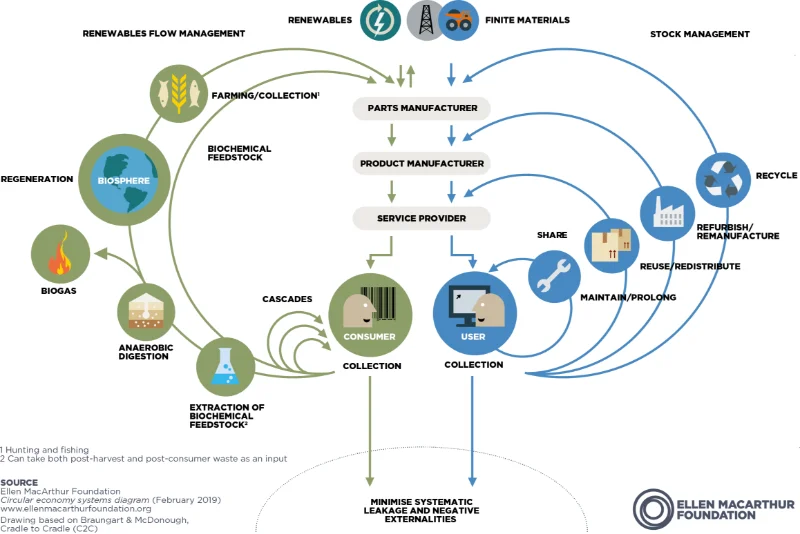
In practical terms, implementing a circular economy means creating loops of positive value at every stage of a product or service lifecycle — by maximizing the use of renewable materials and minimizing the use of limited, non-renewable natural resources. It is a set of hierarchical practices, organized by impact, that takes into account the broader ecosystem and often strengthens relationships with partners.

According to the United Nations 
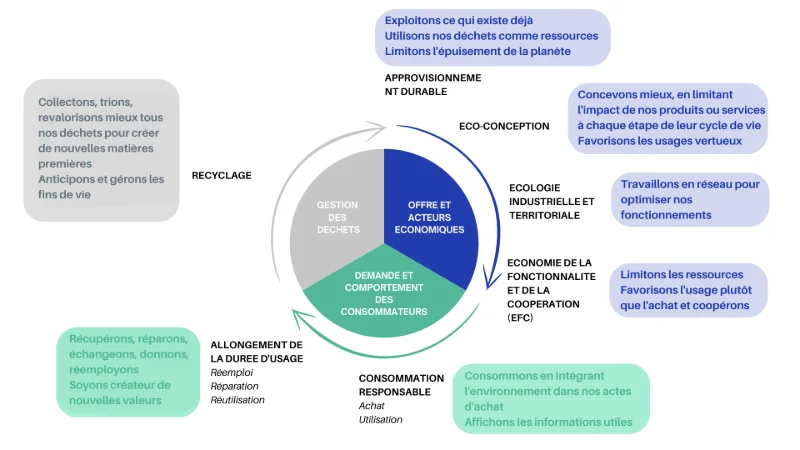
 This model emphasizes new ways of designing, producing and consuming, extending product lifespans, and promoting reuse and recycling of components. As summarized in the illustration: 
  • Products and services must be designed to be efficient, both in their production and their use 
  •  Products and services must be designed to be repairable, with maintenance planned by design 
  •  Products and services must be reused, shared and optimized to maximize their usage 
  •  Products and services must be designed for disassembly, enabling the reuse of functional sub-systems in new products; components that can no longer be remanufactured should be recycled whenever possible
In short, building on the definition from ADEME (the French Agency for Ecological Transition), the circular economy is: 
 “An economic system of exchange and production which, at every stage of the product life cycle (goods and services), aims to increase the efficiency of resource use and reduce our environmental impact, while improving individual well-being.”
Géraldine Carpentier,, chargée de mission économie circulaire à La Réunion Développement
3 areas, 7 principles

3 areas, 7 principles

The circular economy is structured around three main areas and seven established scientific fields, illustrated in the diagram. It promotes the search for concrete, technical and/or organizational solutions involving all socio-economic stakeholders.


Sustainable consomption

Sustainable consomption 

Sustainable consumption is a set of consumption practices that seek to reduce environmental impact and promote social and economic responsibility. It encourages individuals and organizations to choose products and services with lower ecological footprints, favor local and sustainable alternatives,...
Extending product lifespan

Extending product lifespan

Extending product lifespan refers to all practices that increase the period during which a product remains functional and used, delaying the need for replacement. It includes repair, maintenance, reconditioning, refurbishment, reuse, and second-life strategies that keep products and components in...
Recyccle

Recyccle

Toute opération de valorisation par laquelle les déchets, y compris les déchets organiques, sont retraités en substances, matières ou produits aux fins de leur fonction initiale ou à d'autres fins.